







Back
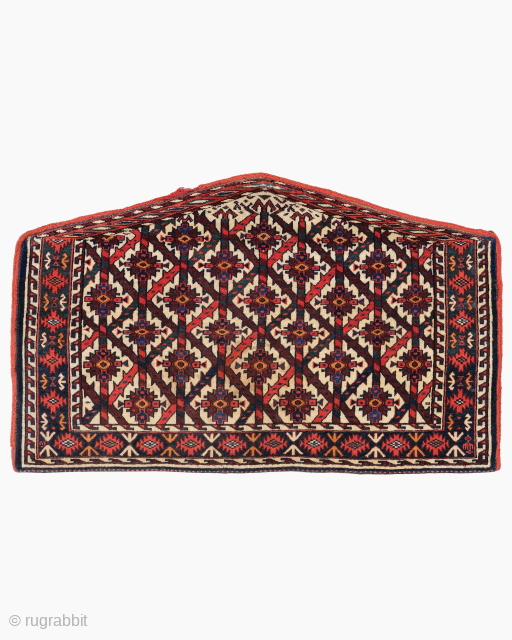
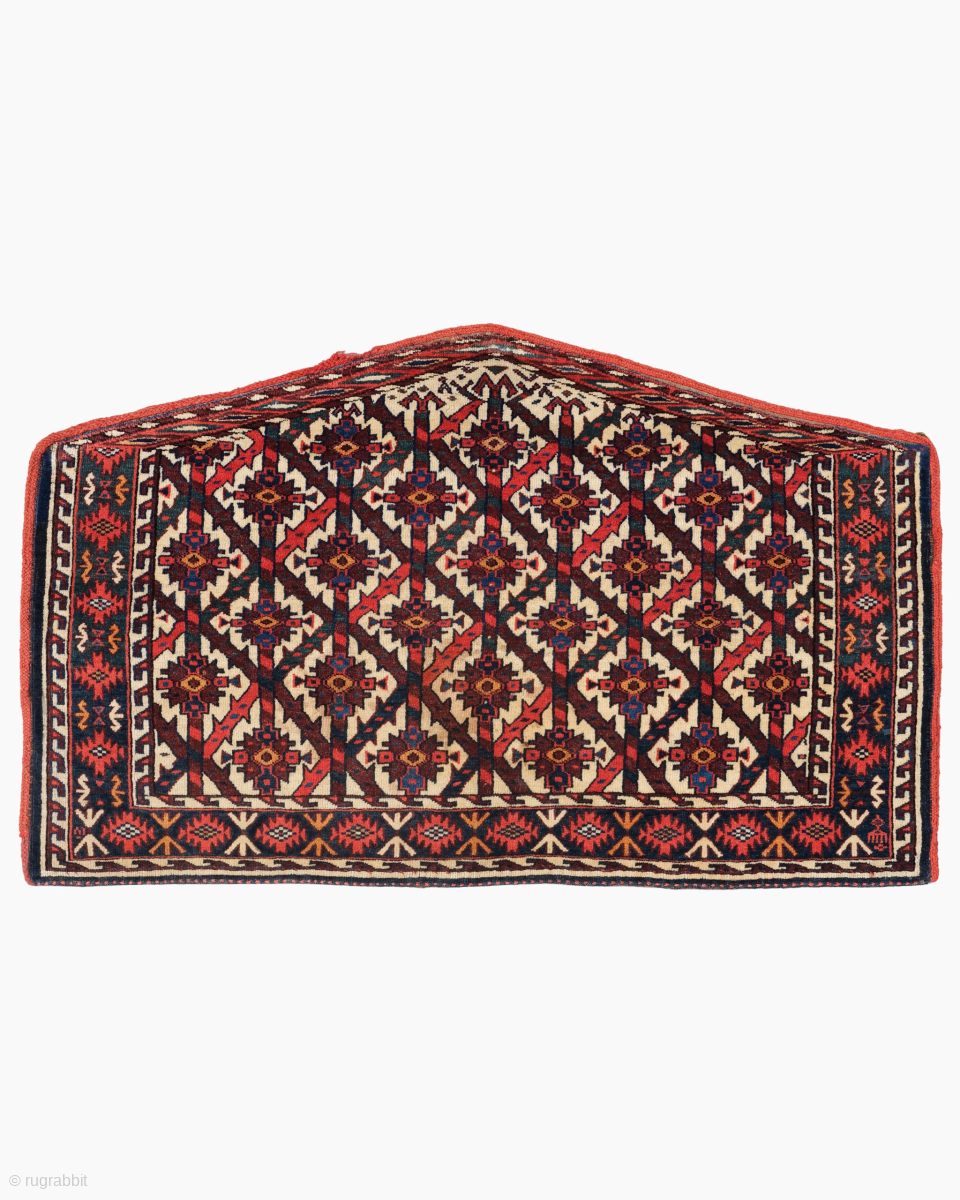

Period: Mid 19th Century
Origin : Yomud, West Turkmenistan
Dimensions : 63 x 105 cm
This rare mid 19th century Yomud Turkmen asmalyk is a striking example of nomadic ceremonial weaving, created for use as a decorative camel trapping during wedding processions. Asmalyks are among the most culturally significant textiles of Turkmen tribes and were woven in pairs to adorn the flanks of the bridal camel.
The composition features a repeating lattice of stepped diamond guls, each enclosing smaller cruciform and hooked motifs. These geometric guls function as tribal emblems, symbolizing identity, protection, and continuity within Yomut Turkmen culture. The precise symmetry and rhythmic repetition reflect the disciplined design tradition characteristic of Yomut weavings.
The color palette is bold and harmonious, dominated by deep madder red, enriched with dark indigo, ivory, soft brown, and touches of turquoise. The use of natural dyes has resulted in a rich patina and subtle tonal variations, enhancing the textiles depth and authenticity.
The borders are framed with angular latch hook motifs, running “s” forms, and stylized ram’s horn elements, reinforcing the strong nomadic aesthetic. Woven with hand-spun wool on a wool foundation, the piece displays excellent structure, crisp drawing, and a robust yet refined handle.
Yomut asmalyks from the mid 19th century are highly prized by collectors for their rarity, cultural importance, and purity of tribal expression. This piece stands as a powerful artifact of Turkmen ceremonial life, embodying both artistic discipline and symbolic meaning.
price:
galleryaydinrugs@gmail.com