





Back
Posted Today

Echoes of the Sultans: a 19th-Century Homage
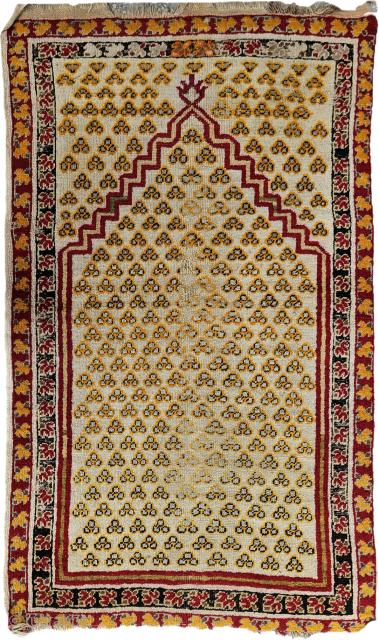
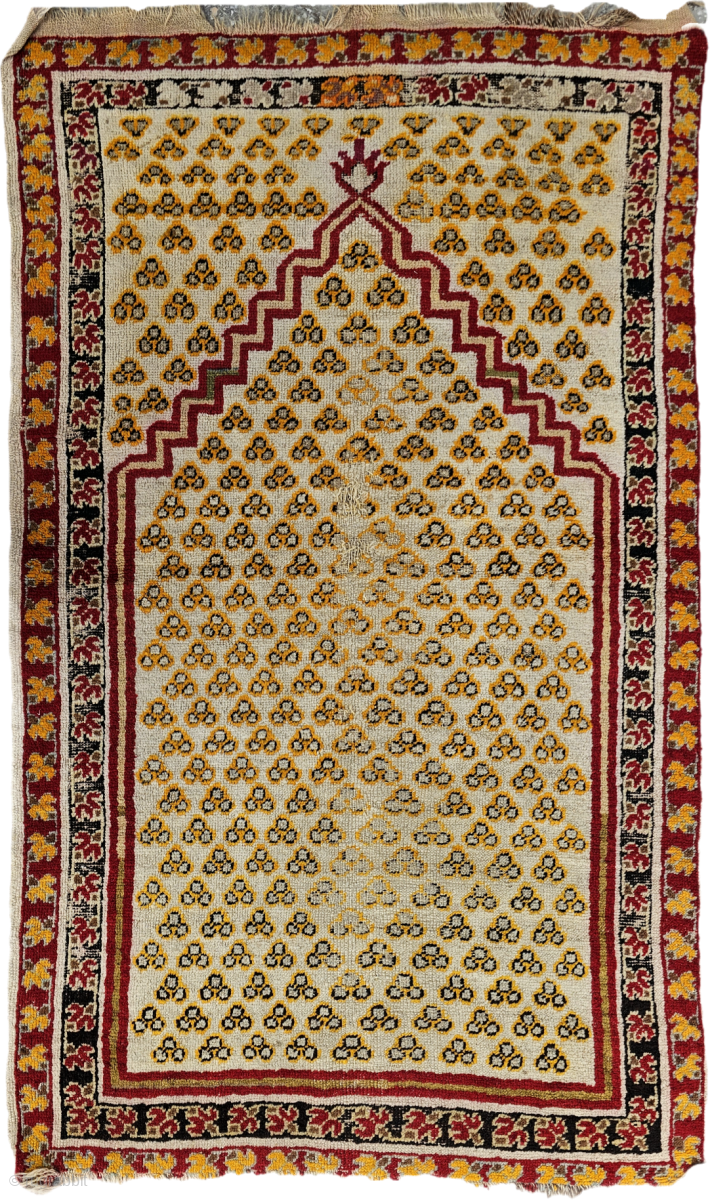
Born in the waning years of the 1800s, this Anatolian rug—likely woven in the storied looms of Mucur or Ghiordes—is not merely a floor covering; it is a whisper from history. It stands as a deliberate, poetic tribute to the legendary 16th-century Selendi rugs, carrying forward a legacy that once graced the imperial courts.
The Soul of the Design
At the heart of this piece lies the Cintamani motif. Originally a symbol of power, protection, and spiritual strength, these three pearls and wavy lines evoke the "Clouds and Dots" seen in the regalia of Ottoman Sultans. Here, against the soft, cream-colored field, the motif is repeated with a rhythmic, meditative grace that feels both ancient and timeless.
The Mihrab’s Embrace
The stepped Mihrab (prayer niche) architecture creates a sacred space within the wool, its deep madder-red outlines providing a grounded contrast to the ethereal light of the center.
Why It Matters
Historical Continuity: It represents a period where weavers looked back to their ancestors to preserve the "Golden Ratio" of Turkish design.
Artisanal Texture: The slight abrashes (color variations) and the weathered fringe tell the story of a century of life, prayer, and presence.
Geography: Whether it hails from the bold geometric traditions of Mucur or the refined elegance of Ghiordes, its soul remains purely Anatolian.
To run one’s hand over this wool is to touch the 16th century through a 19th-century lens. a true collector's piece that proves beauty never fades—it only evolves.
#AntiqueRug #AnatolianArt #Cintamani #OttomanDesign #Selendirug
Size ; 92x150 cm
Central anatolia ...
Detailed information Dm arisoylarmobilya@gmail.com
price:
Ask